



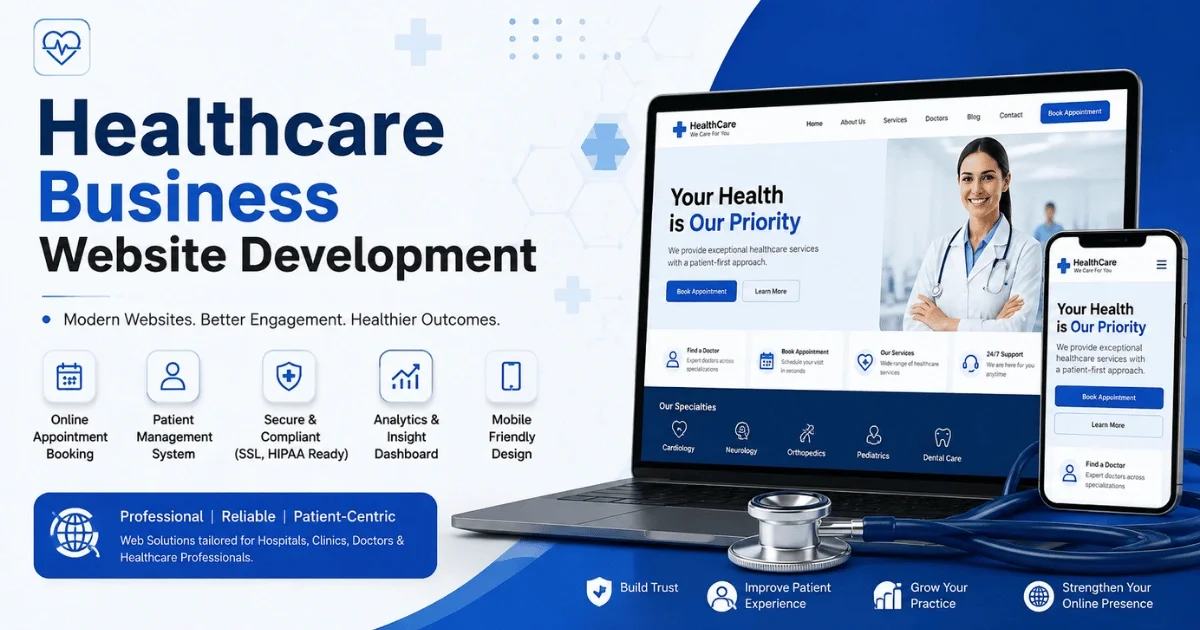
Healthcare Business Website Development: From Booking to AI-Driven Insights

For any patient today, the journey to your hospital or clinic almost always starts online — a quick Google search, a scan of your Practo reviews, a check of doctor profiles, long before anyone dials your reception. This guide breaks down what it actually takes to build a healthcare website that works for the Indian patient: from WhatsApp-based booking and multilingual design to ABDM/ABHA integration, DPDP Act compliance, and where AI is genuinely helping hospitals stretched thin on doctors. Whether you're running a solo clinic in a Tier-2 city or a multi-specialty hospital chain, this is a practical, India-specific look at what to build, what to prioritize, and what it realistically costs.
Why Healthcare Businesses Need a Modern Website
For most Indian patients today, your website isn't a brochure — it's the first stop before OPD registration. Before someone ever calls your reception or walks in, they've likely already Googled your hospital or clinic, checked Practo or Google reviews, compared doctor profiles, and decided whether you're worth the auto ride.
A modern healthcare website matters in the Indian context for very specific reasons:
- India's digital health infrastructure has gone mainstream. With the Ayushman Bharat Digital Mission (ABDM), over 67 crore Ayushman Bharat Health Accounts (ABHA) have already been created, linking patients, hospitals, labs, and pharmacies through a shared digital identity. A hospital or clinic website that ignores this ecosystem is increasingly out of step with where Indian healthcare is heading.
- India has a severe doctor-availability gap. The country runs at roughly 0.8 doctors per 1,000 patients, short of the WHO's recommended 1:1,000 ratio — which makes every OPD slot valuable, and every wasted or no-show slot a real loss for patients waiting in queue.
- Patients now expect digital-first access, even in Tier-2 and Tier-3 cities. Telemedicine, adopted at scale during the pandemic and formalised under the Telemedicine Practice Guidelines, 2020, reset patient expectations — a clinic that still requires a phone call during OPD hours to book an appointment is quietly losing patients to competitors offering WhatsApp or app-based booking.
- Trust is built or lost in seconds, especially with mobile-first patients. A slow, cluttered, English-only website loading poorly on a ₹10,000 smartphone over a patchy 4G connection signals — fairly or not — that the hospital behind it might be similarly outdated in how it treats patients.
- Compliance is now a real legal requirement, not a suggestion. The Digital Personal Data Protection (DPDP) Act, 2023 directly applies to Indian healthcare providers handling patient data, alongside NABH website and data-handling expectations for accredited hospitals.
In short: your website isn't just marketing anymore — it's operational infrastructure that directly affects OPD volume, no-show rates, staff workload at the reception desk, and legal exposure under India's new data protection regime.
Essential Features of a Healthcare Business Website
A healthcare website in India needs to do more than look professional — it needs to work for patients across a huge range of devices, connectivity, and language comfort levels. The essentials:
- Online appointment booking with real-time OPD/doctor availability — ideally with WhatsApp confirmation, since WhatsApp is many Indian patients' default communication channel
- Doctor profiles with qualifications (MBBS, MD, MS, DM, DNB), registration details, specialties, and photos — Indian patients strongly weigh a doctor's credentials and experience before booking
- ABHA-linked patient records access, where feasible, aligning with the national digital health ecosystem
- Multilingual support — at minimum Hindi and English, with regional languages added based on your patient base, since a large share of patients are far more comfortable reading in their mother tongue
- Clear service and department pages organized around how patients actually search ("piles treatment," "IVF centre near me") rather than internal department codes
- Insurance and empanelment information, including accepted TPAs, CGHS/ESI empanelment status, and Ayushman Bharat–PMJAY eligibility where applicable
- Location, directions, and parking details — critical in dense Indian cities where finding a clinic entrance can itself be a challenge
- WhatsApp or live chat support for quick, low-friction queries
- Digital pre-registration forms, reducing the long OPD queue and paperwork common in Indian hospitals
- Genuine patient reviews and testimonials (compliantly handled, without disclosing identifiable health details)
- Emergency contact numbers and ambulance information, prominently and separately displayed from routine OPD booking
- Teleconsultation access, now a mainstream expectation rather than a pandemic-era novelty
The underlying principle: every feature should reduce a patient's anxiety, save them a trip or a queue, or remove a reason to call reception instead of self-serving online.
How Online Booking Improves the Patient Experience
Online booking is one of the highest-leverage investments an Indian healthcare website can make — global research backs this strongly, and the underlying mechanics apply just as much to a Mumbai multi-specialty hospital as a Boston clinic.
A peer-reviewed study found that patients who booked appointments online had a no-show rate of just 1.8%, compared to 5.9% for patients who booked by phone — roughly a threefold difference. That same research found online scheduling cut unused appointment slots from 22.7% down to 10.3%, a meaningful improvement in how efficiently a clinic's OPD calendar gets filled — directly relevant in a country where doctor time is already scarce.
Separately, industry data shows appointments booked online have a show-up rate over 3 times higher than phone-booked ones, and combining self-scheduling with automated reminders can cut missed appointments by 50% or more.
Why this matters even more in India specifically:
- It removes the "engaged tone" problem. Anyone who has tried calling a busy Indian hospital reception during peak OPD hours knows the frustration of a constantly engaged line — online booking sidesteps this entirely.
- It works with WhatsApp, India's dominant messaging platform, for reminders and confirmations, which patients open and trust far more readily than an unfamiliar SMS shortcode.
- It reduces the "OPD line since 6 AM" culture for at least the appointment-taking step, even if physical queuing at the clinic still happens for some services.
- It lowers language and confidence barriers. A patient uncomfortable making a phone call in English can book confidently through a simple, visual, multilingual online form.
The practical takeaway for Indian clinics and hospitals still relying primarily on phone or walk-in booking: this is very likely the single highest-ROI upgrade available — ahead of almost any purely visual redesign.
Healthcare Website Integrations That Matter
A healthcare website in India delivers real value through how well it connects to the broader digital health ecosystem, not just its own features:
- ABDM/ABHA integration — enabling patients to link their 14-digit Ayushman Bharat Health Account for portable, interoperable health records across hospitals, labs, and pharmacies. This is increasingly expected for government hospital partnerships and is becoming a competitive differentiator for private players too.
- Hospital Information System (HIS) / EMR integration — syncing appointment requests and intake data directly into your existing hospital management software, avoiding duplicate manual entry at reception.
- Teleconsultation platforms — compliant with the Telemedicine Practice Guidelines, 2020, which require consultations to be conducted only by Registered Medical Practitioners (RMPs) enrolled with the NMC or state medical councils, with proper patient identification, consent, and record-keeping.
- Payment gateways — Indian gateways supporting UPI, cards, and net banking for OPD fees, deposits, and package payments; UPI in particular is the default expectation for most Indian patients today.
- Insurance and TPA verification tools — letting patients check cashless eligibility before admission, reducing billing confusion at discharge.
- WhatsApp Business API integration — for appointment confirmations, reports, and reminders, given WhatsApp's near-universal reach across Indian smartphone users.
- Pharmacy and lab integrations — for e-prescriptions and online report access, increasingly expected by patients used to app-based diagnostics chains.
- Review and reputation platforms — including Practo, Google, and JustDial, which strongly influence how Indian patients choose a provider.
- Privacy-conscious analytics — with growing scrutiny under the DPDP Act, hospitals should be thoughtful about which analytics and tracking tools receive access to patient-related data.
Every integration handling patient data also needs a clear data-processing agreement with the vendor and DPDP Act–aligned consent mechanisms — not an afterthought once the integration is already live.
AI in Healthcare Website Development
AI is moving from novelty to genuinely useful infrastructure on Indian healthcare websites, particularly given the country's doctor-to-patient ratio pressures.
Where AI is delivering real value:
- AI-powered chatbots and symptom triage — helping patients understand urgency (should this wait for OPD, or does it need emergency care?) before they travel to the hospital, which matters enormously in a country where many patients travel long distances for care.
- Automated appointment scheduling assistants — handling routine booking, rescheduling, and WhatsApp reminders without adding load to an already-stretched reception staff.
- 24/7 patient engagement in regional languages — answering common questions (OPD timings, doctor availability, package pricing) any time, in Hindi or a regional language, reducing the language and time-zone-of-availability barrier many patients face.
- Medication and follow-up reminders — particularly valuable for India's large and growing chronic disease burden (diabetes, hypertension), where automated reminders have been shown to meaningfully improve adherence.
- Administrative automation — reducing paperwork and manual coordination burden on already-stretched front-desk and nursing staff, a particularly acute pain point in high-volume Indian OPDs.
- AI-assisted screening tools — conversational, chatbot-style mental health and chronic condition screening tends to see higher completion rates than paper forms in a crowded, rushed waiting room.
Where to be cautious: Under Indian telemedicine guidelines, AI tools must support and triage — not replace clinical judgment or diagnosis, which must come from an RMP. Any AI tool handling patient health data must also be built with DPDP Act–compliant consent and security safeguards, since health data is explicitly treated as sensitive personal data under the Act.
Data Security & Privacy in Healthcare Websites
This is where Indian healthcare websites face a genuinely new and evolving legal landscape — one that's tightened significantly with the DPDP Act.
What the law actually requires:
- The Digital Personal Data Protection (DPDP) Act, 2023, read with the DPDP Rules, 2025, treats health data — medical history, treatment details, genetic data, mental health information — as sensitive personal data requiring heightened protection. Healthcare providers are classified as "Data Fiduciaries" with direct legal obligations.
- Valid, specific consent is mandatory. Consent must be free, specific, informed, unambiguous, and unconditional, backed by a clear notice explaining exactly what data is collected and why — a vague "I agree to terms" checkbox does not meet this bar.
- Patients (Data Principals) have real, enforceable rights — including the right to access, correct, and request erasure of their digital health data, which your website and backend systems need to be built to actually support, not just promise in a privacy policy.
- Security safeguards are required, including encryption, access controls, and breach-prevention measures appropriate to the sensitivity of health data.
- Penalties are severe. The DPDP Act authorizes fines of up to ₹250 crore for serious violations — a figure large enough that no Indian healthcare provider, regardless of size, can treat compliance as optional.
- Telemedicine adds specific obligations — the Telemedicine Practice Guidelines require patient identification, informed consent, and proper record-keeping for every teleconsultation, and platforms should implement end-to-end encryption for video consultations.
- NABH-accredited hospitals face additional website and data-handling expectations tied to their accreditation standards, on top of DPDP obligations.
A critical, often-missed point for Indian hospitals: DPDP Act compliance and website security are not the same thing as a paper privacy policy — auditors and courts increasingly expect demonstrable consent workflows, access logs, and the actual technical ability to fulfil a patient's access or erasure request, not just a policy document sitting unused on the website footer.
Mobile-Friendly & Accessible Healthcare Website Design
For Indian healthcare websites, mobile-first design isn't a best practice — it's close to the only practice that matters, given how the country accesses the internet.
On mobile: the overwhelming majority of Indian internet users, especially outside metro cities, access the web primarily or exclusively through a smartphone. Patients researching symptoms, checking doctor availability, or booking appointments are very often doing so on a mid-range phone over a mobile data connection — not a laptop on broadband. A healthcare website that isn't genuinely light, fast, and clean on mobile is failing the majority of its actual audience, not a minority edge case.
Practical mobile priorities for Indian healthcare sites:
- Keep page weight low, since many patients are on limited data plans or slower connections outside major cities
- Design booking flows for one-thumb, small-screen use — this is the highest-stakes page on the entire site
- Support regional-language rendering cleanly across devices, including for patients using phones with smaller or older screens
- Ensure WhatsApp-based flows (click-to-chat, booking confirmations) work seamlessly, since this is often the most natural interaction pattern for Indian users
On accessibility: while India's accessibility legal framework (under the Rights of Persons with Disabilities Act) is less litigation-heavy than some Western markets currently, the direction of travel is the same — elderly patients, patients with low digital literacy, and patients with disabilities all benefit directly from clear contrast, large readable text, simple navigation, and properly labelled forms. Building this in now avoids costly retrofits as accessibility expectations and enforcement continue to rise.
SEO for Healthcare Websites
Healthcare SEO in India has its own dynamics, shaped by intense local competition and how Indian patients actually search.
What actually moves the needle:
- Local SEO is often the single highest-impact lever: A well-optimized Google Business Profile — accurate OPD timings, doctor list, photos, and genuine reviews — is critical, since most healthcare searches ("dermatologist near me," "24-hour pharmacy [city]") are hyperlocal and immediate.
- Credibility signals matter heavily: Doctor qualifications, registration numbers, hospital accreditations (NABH, NABL for labs), and genuine patient reviews all build the trust signals Google rewards for medical content, and that Indian patients themselves scrutinise closely before booking.
- City and locality-specific service pages: Built around how patients search regionally ("best maternity hospital in Andheri" rather than generic "obstetrics department") — tend to outperform generic national pages for local clinics and hospitals.
- Multilingual and Hinglish search behaviour: Many Indian patients search in a mix of English and transliterated Hindi ("bukhar ka ilaj," "piles ka operation"); healthcare content that anticipates this captures meaningfully more search traffic than English-only content.
- Platform presence beyond your own website: Practo, Google, and JustDial listings often influence discovery as much as, or more than, organic search rankings for individual clinics, so SEO strategy should account for these platforms too.
- Fast, mobile-optimized pages: Given how much Indian healthcare search happens on mobile data connections, page speed has an outsized effect on both rankings and actual patient conversion.
Like SEO everywhere, healthcare SEO in India is a compounding, multi-month investment — early signals in roughly 3–6 months, with more durable local visibility typically building over 6–12 months of consistent work.
Website Performance & Core Web Vitals
Speed and technical health aren't cosmetic for an Indian healthcare website — they directly affect patient experience on the mobile-data connections most patients are actually using, and they affect Google rankings too.
Core Web Vitals are Google's key technical performance metrics:
- Largest Contentful Paint (LCP) — how quickly the main content loads (target: under 2.5 seconds) — especially important given variable network quality across Indian cities and towns
- Interaction to Next Paint (INP) — how responsive the page is to taps, critical for booking forms used on mid-range phones
- Cumulative Layout Shift (CLS) — whether elements jump around while loading, a common frustration on slower connections where images load in gradually
For an Indian healthcare website, poor performance compounds in a very specific way: a slow-loading booking form on a patient's 4G connection doesn't just hurt SEO — it directly increases the odds a patient gives up and either calls reception (reintroducing the phone-booking no-show problem) or simply chooses a competitor's app instead.
Practical priorities:
- Compress images aggressively — hero banners and doctor photos are often the biggest single cause of slow load times
- Avoid heavy animation and script bloat on the booking and intake pages specifically
- Choose Indian or India-region-optimized hosting/CDN to reduce latency for local patients
- Test the mobile booking flow specifically on a mid-range Android device over a throttled connection, not just on a high-end phone over office WiFi
Healthcare Website Admin Panel & Automation
Behind the patient-facing site, a well-built admin panel is what actually saves your reception and administrative staff real time day to day:
- Centralized OPD appointment management — viewing, confirming, and adjusting bookings across doctors and departments from one dashboard
- Automated WhatsApp and SMS reminder workflows — appointment reminders, report-ready notifications, and follow-up recalls running without manual staff calling
- Content updates without developer dependency — hospital administrators should be able to update OPD timings, doctor availability, and announcements themselves
- Form and intake routing — patient registration data flowing directly into your Hospital Information System, reducing duplicate paper-and-digital entry
- Role-based access controls — reception, nursing, and administrative staff seeing only what's relevant to their role, both a workflow efficiency and a DPDP Act data-minimisation requirement
- Simple analytics dashboards — booking conversion, no-show trends, and traffic sources visible without a separate reporting request to IT
Every manual task automated here is one less opportunity for error in an Indian hospital environment where reception and nursing staff are often already stretched across high patient volumes.
How Much Does Healthcare Website Development Cost?
Costs in India vary significantly by practice size and feature complexity. Realistic current ranges:
| Practice Type | Typical Website Build Cost | Ongoing Monthly Cost |
| Solo practitioner / small clinic, essential features | ₹25,000 – ₹60,000 | ₹2,000 – ₹8,000 |
| Mid-sized clinic with online booking & WhatsApp integration | ₹35,000 – ₹75,000 | ₹5,000 – ₹15,000 |
| Growing multi-doctor practice with HIS/EMR integration | ₹55,000 – ₹1,00,000 | ₹10,000 – ₹40,000 |
| Hospital/multi-specialty centre with ABHA, patient portal, telemedicine | ₹1,50,000 – ₹20,00,000+ | ₹40,000 – ₹1,50,000+ |
Where the money goes beyond basic design:
- Secure, appropriately isolated hosting for patient data, rather than the cheapest shared hosting plan
- DPDP Act compliance work — consent management workflows, privacy notices, and data-subject-request handling built into the actual system, not just documented in policy
- HIS/EMR and ABDM integration development — technical work to connect your website to existing hospital systems and the national health ecosystem
- NABH-related digital documentation support, if your hospital is pursuing or maintaining accreditation — note that full NABH accreditation itself (a separate, broader process from the website) typically runs into several lakhs to tens of lakhs depending on hospital size, so website compliance work is a smaller but related piece of that larger investment
- Multilingual content development — translating and localizing content properly, not just running it through machine translation
The clearest overall pattern: proper security, DPDP compliance, and integration work meaningfully add to the base cost of a simple template website — but that premium is small compared to the reputational and legal cost of a data breach or non-compliance penalty under the DPDP Act's ₹250 crore maximum fine ceiling.
How to Choose the Right Healthcare Website Development Company
Not every web agency in India is equipped to build a compliant healthcare website. Vet potential partners on:
- Proven healthcare-sector experience in India specifically — ask for real examples of hospital or clinic websites they've built, including how they handled patient data
- Demonstrable DPDP Act awareness — they should be able to explain, specifically, how they handle consent capture, data minimisation, and security safeguards — vague reassurance without specifics is a warning sign
- ABDM/ABHA integration capability, if relevant to your growth plans, since this increasingly matters for government partnerships and patient expectations alike
- WhatsApp Business API and UPI payment integration experience, given how central both are to the Indian patient journey
- Multilingual development capability, not just English-first design with translation bolted on afterward
- Understanding of NABH-related digital requirements, if your hospital is accredited or pursuing accreditation
- Transparent, itemized pricing — hosting, compliance work, and integrations should be clearly broken out, not buried in one vague number
- References from similarly sized Indian practices — an agency built for large corporate hospital chains may be a poor and overpriced fit for a solo practitioner's clinic, and vice versa
The right partner treats DPDP compliance, mobile performance, and India-specific integrations (ABHA, WhatsApp, UPI) as core requirements from day one — not features bolted on after a compliance scare or a patient complaint.
Future of Healthcare Website Development
A few clear directions are shaping where Indian healthcare websites are headed next:
Deeper ABDM integration becomes the norm, not the exception: With ABHA already linking over 67 crore health accounts nationally, patients will increasingly expect their records to be portable across the hospitals and clinics they visit — websites that don't support this will look noticeably behind competitors that do.
AI-driven triage and regional-language support scale up: Given India's doctor-availability constraints, AI tools that help patients self-triage and access basic guidance in their own language — before ever needing a doctor's time — will become a meaningful differentiator, especially for hospitals serving Tier-2 and Tier-3 patients.
DPDP Act enforcement matures: As the DPDP Rules, 2025 come into fuller effect, expect stricter scrutiny of consent practices and data handling specifically in healthcare — providers who build compliant systems now avoid costly retrofits and potential penalties later.
Teleconsultation becomes fully embedded, not a separate offering: Rather than a bolted-on video-call link, expect telemedicine, in-person booking, and digital records to increasingly live inside one unified patient experience, aligned with the Telemedicine Practice Guidelines framework.
WhatsApp remains the default interface for a huge share of patient interaction: Given its near-universal reach in India, expect more hospitals to build their entire patient communication — booking, reminders, reports, follow-ups — around WhatsApp rather than email or app notifications, which many patients check far less frequently.
Conclusion
A healthcare business website in India in 2026 has to do more than look professional — it has to work reliably on a mid-range phone over patchy data, support the language a patient is actually comfortable in, connect meaningfully to India's growing digital health ecosystem through ABDM and ABHA, and handle patient data in a way that genuinely satisfies the DPDP Act — not just a privacy policy nobody reads. The data is clear on where the highest returns lie: online booking alone can cut no-show rates by more than half in a country where every OPD slot is precious, and building DPDP-compliant systems now is far cheaper than facing penalties or losing patient trust later. The Indian hospitals and clinics winning online aren't necessarily the ones with the most expensive websites — they're the ones building genuinely patient-first, mobile-first, and compliance-first digital infrastructure from day one.