



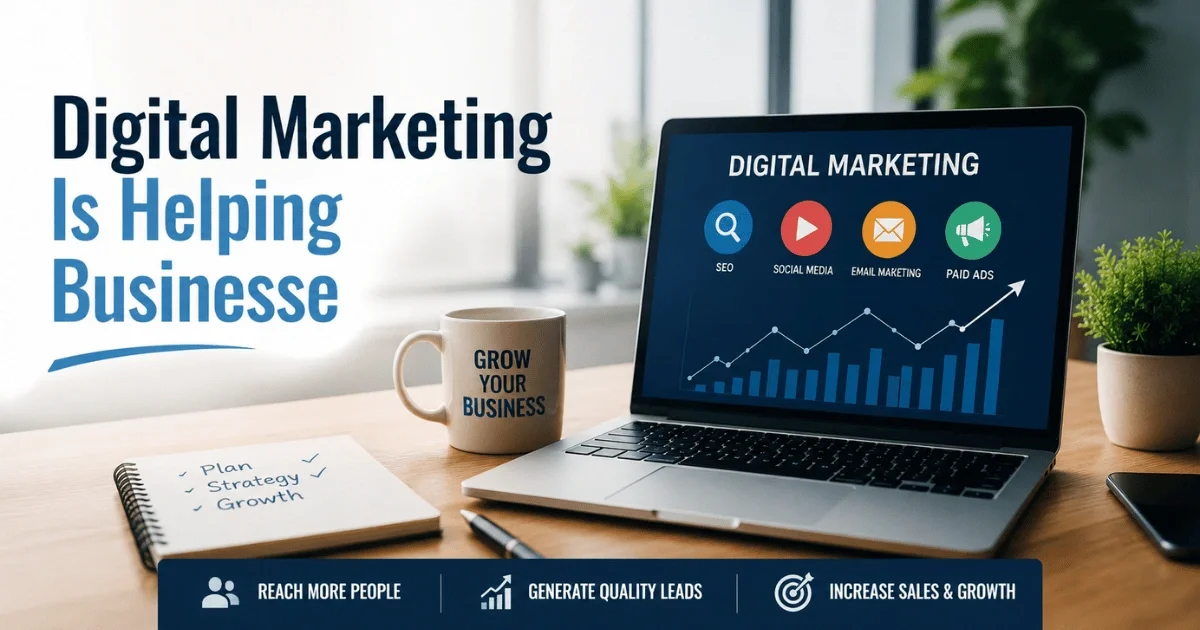
How Digital Marketing Is Helping Businesses to Grow their Sales

Every purchase decision today starts with a search, a scroll, or an email — long before a customer ever talks to your sales team. This guide breaks down exactly how digital marketing drives real business growth: from SEO and paid ads to email and content marketing, the strategies that actually move the needle, how long each one realistically takes to pay off, and the mistakes that quietly waste most small business marketing budgets. Whether you're building your first strategy from scratch or trying to figure out why your current efforts aren't converting, this is a practical, no-jargon walkthrough of what works — and how to measure it.
What Is Digital Marketing?
Digital marketing is the practice of promoting your business, products, or services through online channels — search engines, social media, email, websites, apps, and paid advertising — instead of (or alongside) traditional offline methods like print, TV, and billboards.
In practical terms, it covers everything a business does to be found, trusted, and chosen online:
- Search Engine Optimization (SEO) — getting your website to rank in Google/Bing search results
- Pay-Per-Click advertising (PPC) — paid ads on Google, Bing, or social platforms
- Social media marketing — organic posting and paid ads on Instagram, Facebook, LinkedIn, TikTok, etc.
- Content marketing — blogs, guides, videos, and resources that attract and educate potential customers
- Email marketing — nurturing leads and customers directly through their inbox
- Affiliate and influencer marketing — partnering with others to promote your product
- Marketing analytics — tracking what's actually working, in real time
The core difference from traditional marketing isn't just "online vs. offline" — it's measurability. Every click, impression, email open, and sale can be tracked back to the exact campaign that produced it. That single fact is what makes digital marketing so powerful for driving sales: you can see what's working and pour more budget into it, instead of guessing.
Why Digital Marketing Is Important for Business Growth
The numbers make the case better than opinion can. Digital advertising now accounts for roughly 69% of total global ad spend, and the global digital advertising market has climbed past the $1 trillion mark. That's not a niche channel anymore — it's where the majority of commercial attention already lives.
A few reasons digital marketing has become non-negotiable for growth:
- Your customers are already there. Social media alone reaches roughly two-thirds of the world's population. If your business isn't visible where people are already spending their time, a competitor's is.
- It's measurable in a way traditional marketing never was. You can know, to the dollar, what a campaign cost and what it returned — something a billboard or a radio spot can never tell you precisely.
- It's accessible at almost any budget. A local bakery and a national retailer can both run a Facebook ad campaign or start a blog. Digital marketing doesn't require the six- or seven-figure minimums that traditional TV or print advertising often does.
- It compounds. Unlike a paid ad that stops working the moment you stop paying, well-built SEO content and an engaged email list keep generating leads and sales long after the initial work is done.
- It builds trust before the first conversation. Most buyers research a business online — reviews, website, social proof — before ever reaching out. A strong digital presence does a huge amount of the "selling" before your team even picks up the phone.
Businesses that treat digital marketing as optional are increasingly competing with one hand tied behind their back — not because digital is trendy, but because that's simply where buying decisions now get made.
8 Ways Digital Marketing Helps Businesses Grow
1. It puts you in front of people actively searching for what you sell.
Unlike traditional ads that interrupt people, SEO and search ads reach someone at the exact moment they're typing "best [your product] near me." That intent-driven traffic converts at a dramatically higher rate than cold outreach, because the buyer is already looking for a solution — you just need to be the answer they find.
2. It expands your reach far beyond your local footprint.
A physical store is limited by geography. A website, social presence, and ad campaigns aren't. A small business can reach customers in other cities, states, or countries with the same website that used to only serve walk-in traffic.
3. It lets you target the exact customer you want.
Paid social and search platforms let you target by age, location, interests, job title, past purchase behaviour, and more. Instead of paying to reach everyone, you pay to reach the people most likely to actually buy — which lowers cost per lead and raises conversion rates.
4. It builds trust through content and reviews before the sale happens.
Helpful blog content, case studies, and visible customer reviews let a prospect evaluate your credibility on their own time, at their own pace — which means by the time they contact you, much of the trust-building (and often the decision) is already done.
5. It nurtures leads automatically, even while you sleep.
Email automation, retargeting ads, and chatbots keep following up with a prospect who wasn't ready to buy on day one — without needing a salesperson to manually remember to follow up. Email marketing alone delivers one of the highest returns of any channel, commonly cited between $36 and $42 back for every $1 spent, largely because of this automated, ongoing nurture.
6. It turns one-time buyers into repeat customers.
Retargeting ads, loyalty email sequences, and personalized offers keep your business top-of-mind after the first sale — and it's dramatically cheaper to sell to an existing customer than to acquire a new one.
7. It gives you real-time data to improve constantly.
Every campaign produces data: which headline got clicked, which page caused people to leave, which ad converted best. Traditional marketing rarely offers this kind of feedback loop. Digital marketing lets you test, learn, and improve every month instead of guessing once a year.
8. It levels the playing field against bigger competitors.
A well-optimized website and a sharp content strategy can outrank a much larger competitor's underperforming site. Digital marketing rewards relevance and quality of execution, not just the size of your ad budget — which is why small, focused businesses can often punch above their weight online.
Key Digital Marketing Strategies for Business Growth
Search Engine Optimization (SEO)
Optimizing your website's content, structure, and technical health so it ranks organically in search results. SEO is estimated to drive over half of all website traffic and consistently ranks among the highest-ROI channels for B2B businesses, because it keeps generating traffic without an ongoing per-click cost.
Pay-Per-Click Advertising (PPC / Google Ads)
Paid search ads that put you at the top of results instantly, rather than waiting months for organic rankings. Commonly cited returns are around $8 back for every $1 spent on Google Ads — strong, though generally lower than organic channels once you factor in the ongoing cost of running ads.
Content Marketing
Blogs, guides, videos, and downloadable resources built to answer your customers' questions and pull them toward your business organically. It's a compounding asset — content published today can keep generating traffic and leads years later.
Social Media Marketing
A mix of organic posting (building community and brand awareness) and paid social ads (targeted reach and direct response). Paid social advertising is commonly cited as returning around $5 for every $1 spent for small and mid-sized businesses.
Email Marketing
Consistently the highest-ROI digital channel by a wide margin, largely because of low cost and the ability to segment and personalize messages to specific customer groups. Targeted, segmented campaigns have been shown to generate significantly more revenue than generic "batch and blast" sends.
Video Marketing
Short-form video in particular has become one of the most-used and highest-converting content formats, with growing marketer investment in video across both organic and paid channels.
Influencer and Affiliate Marketing
Partnering with creators or other businesses to promote your product to their existing audience — useful for building trust quickly in a new market or niche.
Marketing Automation and AI Personalization
Using software and AI tools to automatically send the right message to the right person at the right time — from abandoned cart emails to AI-optimized subject lines, which have been shown to noticeably lift open rates compared to manually written ones.
Digital Marketing for Small Businesses
Small businesses often assume digital marketing is a "big company" game — it isn't, and in some ways it favors small, agile teams.
Where to start with a limited budget:
- Claim and optimize your Google Business Profile. It's free, and it's often the single highest-impact thing a local business can do — it directly affects whether you show up in local map searches.
- Prioritize one or two channels, not all of them. A small business trying to run SEO, paid ads, email, and four social platforms simultaneously usually does all of them poorly. Pick the one or two channels where your customers actually spend time and go deep.
- Use email early. It's the cheapest channel to start and consistently delivers the strongest return relative to spend — even a small, well-segmented list can outperform a much larger ad budget.
- Lean on customer reviews and word-of-mouth amplification. Encouraging happy customers to leave reviews and share your business on social media costs little but strongly influences buyer trust.
- Use free and low-cost tools before paying for enterprise software. Google Analytics, Google Search Console, Canva, and free tiers of email platforms cover most of what a small business needs in year one.
On budget: there's no single universal rule, but many small businesses find a workable starting point is treating marketing as an ongoing operating cost rather than a one-time expense — even a modest, consistent monthly investment in one channel (like content plus email) tends to outperform a large one-time burst of spending followed by silence.
On patience: small businesses that succeed with digital marketing tend to share one trait — they stick with a channel long enough to see it compound, rather than switching strategies every couple of months because results didn't come immediately.
How to Create a Digital Marketing Strategy for Your Business
Step 1: Define a specific, measurable goal.
"Get more sales" isn't a strategy. "Generate 30 qualified leads per month from organic search within 6 months" is. A clear goal tells you which channels matter and how you'll know if it's working.
Step 2: Know exactly who you're targeting.
Build a simple customer profile: who they are, what problem they have, where they spend time online, and what would make them trust a business like yours. Every channel and message decision should trace back to this.
Step 3: Audit what you already have.
Look at your current website, social presence, and past marketing efforts. What's already generating traffic or leads, even a little? Build on existing traction rather than starting from zero.
Step 4: Choose 2–3 channels — not all of them.
Based on your goal and your customer profile, pick the channels most likely to reach them. A B2B software company and a local restaurant should not be running the same channel mix.
Step 5: Create a realistic content and campaign calendar.
Digital marketing rewards consistency far more than intensity. A steady cadence of content or ads over months beats a big one-time push followed by silence.
Step 6: Set a budget and stick to it long enough to know if it's working.
Especially for SEO and content, results take months to show up — pulling the plug at month two before results appear is one of the most common ways businesses waste their initial investment.
Step 7: Track results and adjust monthly.
Use analytics to see what's actually converting, not just what's getting clicks or likes. Shift budget toward what's producing real leads and sales, and cut what isn't — regardless of how much you initially liked that channel.
Common Digital Marketing Mistakes Businesses Should Avoid
- Trying to do everything at once: Spreading a limited budget across five channels usually produces weak results everywhere instead of strong results anywhere. Depth beats breadth, especially for small businesses.
- Giving up too early, especially on SEO: Since organic search commonly takes three to six months to show early movement and six to twelve months for meaningful growth, businesses that quit at month two before results compound are the most common source of "SEO doesn't work" complaints — when in reality, the timeline simply wasn't respected.
- Not tracking ROI by channel: Without clear tracking, businesses often keep spending on the channel that "feels" like it's working rather than the one the data shows is actually converting.
- Ignoring mobile experience: A huge share of traffic and purchase research now happens on phones — a slow or clunky mobile site quietly kills conversions before a visitor ever reaches your offer.
- Buying followers, backlinks, or fake engagement: Shortcuts like purchased backlinks or bot followers create short-term vanity metrics but real long-term risk — search engines and platforms actively penalize manipulative tactics, and it can set a business back further than doing nothing at all.
- Sending generic, un-segmented emails: Batch-and-blast email underperforms significantly compared to targeted, segmented campaigns — treating your whole list identically leaves a large amount of revenue on the table.
- Neglecting existing customers in favour of only chasing new ones: Retention and repeat-purchase campaigns are often cheaper and more profitable than constant new-customer acquisition, but get far less attention in most small business marketing plans.
- Not aligning marketing with actual sales goals: Chasing traffic, followers, or impressions that never translate into leads or revenue is activity without outcome — every channel should ultimately tie back to a business result.
How Long Does Digital Marketing Take to Show Results?
This varies significantly by channel, and setting the right expectations up front prevents businesses from abandoning strategies right before they start working.
- Paid ads (Google Ads, social ads): Fastest channel — visibility and traffic can begin within 24 hours of launch, though it typically takes a few weeks of testing to optimize cost-per-lead.
- Email marketing: Results can show within days to weeks once you have a list, since you're reaching people who already know your business.
- Social media marketing: Organic growth typically takes 2–3 months to build meaningful engagement; paid social can drive traffic immediately but needs testing time to find winning creative.
- SEO and organic content: The slowest but most compounding channel. Early signals (indexing, small traffic upticks) commonly appear within 30–90 days; meaningful ranking and traffic growth in the 3–6 month range; and significant, durable business impact — leads and revenue — typically in the 6–12 month range, sometimes longer in highly competitive industries.
The practical takeaway: use paid channels for near-term visibility while SEO and content build in the background, then gradually shift budget toward organic channels as they mature — many businesses find that by month six to eight, organic traffic is contributing enough that paid spend can be reduced without losing overall lead volume.
How to Measure Digital Marketing Success
Vanity metrics (likes, impressions, followers) feel good but don't pay bills. Focus measurement on metrics tied to actual business outcomes:
- Website traffic and traffic sources — where visitors are coming from (organic, paid, social, email, direct), so you know which channels are pulling weight
- Conversion rate — the percentage of visitors who take a desired action (purchase, form fill, call, sign-up)
- Cost Per Lead (CPL) and Customer Acquisition Cost (CAC) — what you're actually paying to get a new lead or customer through each channel
- Return on Investment (ROI) / Return on Ad Spend (ROAS) — revenue generated relative to what was spent, per channel
- Email open and click-through rates — engagement signals for your list's health and content relevance
- Organic keyword rankings and impressions — leading indicators for SEO, which typically move before traffic and revenue do
- Customer Lifetime Value (CLV) — how much a customer is worth over their full relationship with your business, which helps you judge whether your CAC is actually sustainable
- Bounce rate and time on site — signals of whether your website content and experience are actually engaging the traffic you're paying to bring in
The core discipline: track leading indicators (traffic, rankings, engagement) early, but always tie your evaluation back to lagging, revenue-based indicators (leads, sales, CAC, ROI) before deciding whether a strategy is working.
Conclusion
Digital marketing helps businesses grow sales because it does something traditional marketing structurally can't: it puts you directly in front of people who are actively looking for what you sell, measures exactly what's working, and lets you improve continuously instead of guessing. It's not a single tactic — it's a system of channels (SEO, paid ads, content, email, social) that work best together, each playing a different role from immediate visibility to long-term compounding growth. The businesses that see the strongest results aren't necessarily the ones with the biggest budgets — they're the ones who pick a focused strategy, track it honestly, and give it enough time to actually work.