



Lead Generation for Service-Based Businesses: A Practical Guide

Consistent leads are essential for service-based businesses. This guide covers practical strategies to attract qualified prospects, generate enquiries through SEO, paid ads and your website, and turn those leads into customers.
Service businesses live and die by their pipeline. Unlike product companies that can rely on marketplaces, ads, or viral loops, a plumbing company, law firm, marketing agency, or accounting practice depends almost entirely on consistent, qualified leads walking (or clicking) through the door. Yet most service businesses treat lead generation as a series of disconnected tactics, a Facebook ad here, a referral ask there, instead of a system. This guide breaks down what actually works, based on how successful service businesses build repeatable pipelines.
Start With the Right Lead Generation Strategy
Before touching a single channel, you need clarity on three things: who you're targeting, what they're worth, and what "qualified" actually means for your business.
Define your ideal client by economics, not demographics. Most service businesses default to vague targeting ("homeowners," "small businesses") when the real filter should be lifetime value and cost to serve. A home renovation company that books a ₹1.5 lakh bathroom refresh and a ₹50 lakh full-home renovation from the same ad spend is not actually running one business, it's running two, with wildly different acquisition economics. Segment your past 12-24 months of clients by revenue and profit, not just revenue, and you'll usually find 20% of your client types generated 70–80% of your profit. That's who your lead gen should chase.
Know your numbers before you spend a single rupee. Three figures should drive every decision:
- Customer Acquisition Cost (CAC) — total marketing + sales spend divided by new clients won
- Average Client Value (ACV) — average revenue per client, ideally including repeat/referral value over 12 months
- Sales cycle length — how long from first contact to signed deal
A consulting firm with a ₹12 lakh average deal size can profitably spend ₹1–2.5 lakh to acquire a client. A residential cleaning service with a ₹12,000/month contract cannot. Yet many service businesses copy tactics from industries with completely different unit economics, a Tier-1 city interior design firm running the same playbook as a local AC repair business will burn cash chasing the wrong benchmarks.
Pick a strategic lane before diversifying. The two dominant strategic approaches for service businesses are:
Authority-led generation — content, referrals, and reputation drive inbound demand (works well for high-ticket, considered purchases: legal, consulting, financial advisory, high-end contracting)
Direct-response generation — paid ads and outbound drive immediate demand capture (works well for urgent, lower-consideration services: locksmiths, HVAC repair, pest control, towing)
Most mature service businesses eventually run both, but trying to do both from day one with limited budget usually means doing neither well.
Build Your Lead Generation System
A lead generation system as opposed to a set of tactics, has four components that need to work together: capture, nurture, qualify, and convert.
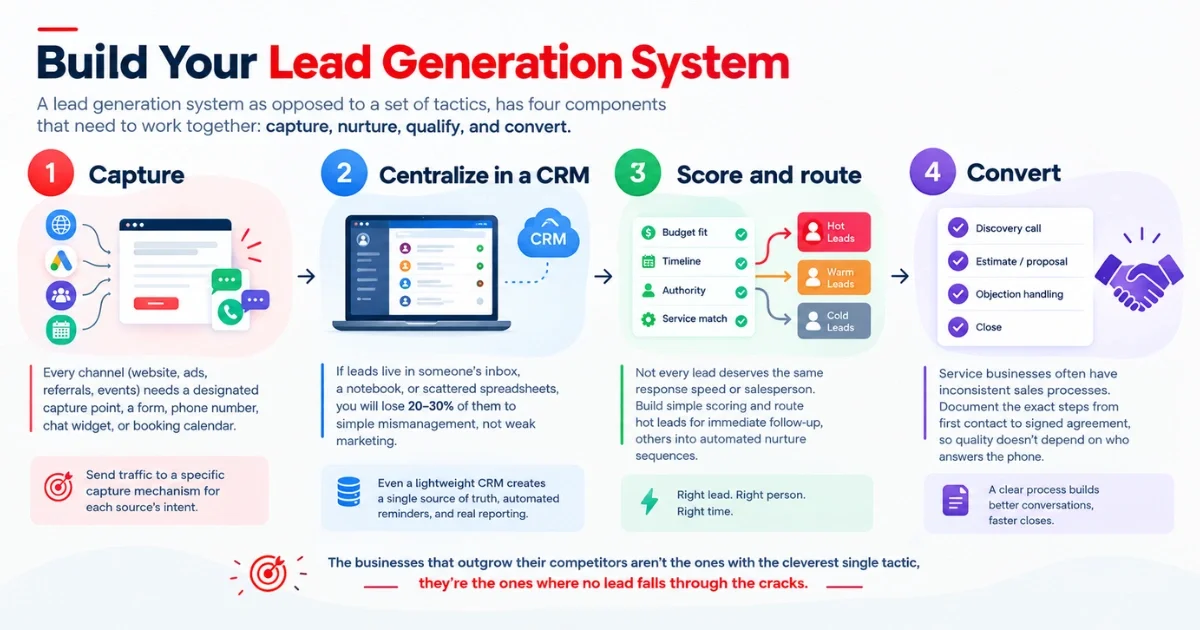
1. Capture. Every channel (website, ads, referrals, events) needs a designated capture point, a form, phone number, chat widget, or booking calendar. The mistake most businesses make is sending traffic to a generic homepage with no clear next action. Every traffic source should map to a specific capture mechanism designed for that source's intent level.
2. Centralize in a CRM. If leads live in someone's inbox, a notebook, or scattered spreadsheets, you will lose 20–30% of them to simple mismanagement, not weak marketing. Even a lightweight CRM (HubSpot free tier, Pipedrive, Jobber, House call Pro for trades) creates a single source of truth, automated reminders, and reporting you can actually act on.
3. Score and route. Not every lead deserves the same response speed or salesperson. Build simple scoring: budget fit, timeline, decision-making authority, and service match. Route hot leads (ready to buy, budget confirmed) for immediate human follow-up, and warm/cold leads into automated nurture sequences.
4. Convert with a defined sales process. Service businesses often have inconsistent sales processes because the "salesperson" is also the technician, consultant, or owner. Document the exact steps from first contact to signed agreement, discovery call, estimate/proposal, objection handling, close, so quality doesn't depend on who happens to answer the phone that day.
The businesses that outgrow their competitors aren't the ones with the cleverest single tactic, they're the ones where no lead falls through the cracks.
Best Lead Generation Channels for Service Businesses
Different channels suit different service types, budgets, and sales cycles. Here's how to think about the major ones realistically:
Google Business Profile (GBP) / Local SEO — For any business serving a geographic area, this is often the highest-ROI channel because intent is already high (someone searching "emergency electrician near me" is close to buying). Consistent reviews, accurate categories, photos, and Q&A responses meaningfully affect the local 3-pack ranking.
Google Local Services Ads (LSAs) — Pay-per-lead (not pay-per-click) ads that appear above regular search results for trades like plumbing, HVAC, legal, and cleaning. Because you only pay for actual leads (calls/messages) and get a Google Guarantee badge, LSAs frequently outperform standard Google Ads on cost-per-lead for local service categories.
Google Search Ads (PPC) — Best for services with clear, high-intent search terms ("divorce lawyer in [city]," "commercial roof repair"). Requires disciplined negative keyword management and dedicated landing pages, sending PPC traffic to a generic homepage routinely cuts conversion rates in half.
Meta Ads (Facebook/Instagram) — Works better for demand generation than demand capture. Effective for services people don't actively search for but recognize they need once shown (home organizing, financial planning, aesthetic treatments). Video testimonials and before/after content typically outperform static ad creative for services.
Referral programs — The most underused, highest-converting channel for most service businesses. Referred clients typically close faster and churn less because trust is pre-established. Yet most businesses ask for referrals passively ("let us know if you know anyone") instead of building a structured ask, timed right after a positive outcome, with a specific incentive and an easy way to refer (a shareable link or simple form).
Content marketing & SEO — Slower to compound but durable. Especially effective for high-consideration B2B and professional services (agencies, consultants, accountants) where prospects research extensively before buying. A well-ranked "how much does X cost" or "how to choose a Y" article can generate leads for years with no ongoing spend.
Email marketing / newsletters — Underrated for nurturing leads who aren't ready to buy yet. Service sales cycles for big-ticket work (remodelling, legal, consulting) can run 3–12 months; a monthly newsletter keeps you top-of-mind so you're the first call when timing is right.
LinkedIn (B2B services) — For consultants, agencies, and B2B service providers, organic posting plus targeted outreach to specific job titles at specific company sizes tends to outperform broad LinkedIn ads, which get expensive fast.
Partnerships and strategic alliances — Real estate agents referring to contractors, CPAs referring to financial advisors, wedding planners referring to caterers. Complementary (non-competing) businesses serving the same client at a different stage are a durable, low-cost lead source once the relationship is formalized.
The realistic approach: pick 2–3 channels that match your sales cycle and budget, execute them well for 90 days, measure, then expand, rather than spreading thin across seven channels at once.
Create a Website That Generates Leads
For service businesses, the website's job isn't to look impressive, it's to convert visitors who are already interested into people who take action.
Above the fold, answer three questions immediately: What do you do, who do you do it for, and what should I do right now? A visitor who has to scroll to find your phone number or scope of service is a visitor you're about to lose, most site visits are decided in under 10 seconds.
Every page needs one primary call to action. Multiple competing CTAs (call us, email us, download this, chat now, fill this form) reduce conversion because they force a decision instead of guiding one. Pick the CTA that matches the visitor's likely intent (a call button for urgent/local services, a form or calendar link for considered B2B services) and repeat it consistently.
Build dedicated landing pages per service and per location. A general contractor with one page covering "kitchens, bathrooms, additions, and roofing" converts worse than four dedicated pages, each speaking directly to that specific need, with relevant photos, pricing signals, and FAQs. This also compounds your SEO, since Google rewards specificity over generic coverage.
Social proof needs to be specific, not generic. "Great service, highly recommend!" convinces almost nobody. Testimonials that name the specific problem solved, the outcome achieved, and ideally include a photo, name, and location build far more trust. Case studies with numbers (e.g., "reduced their monthly software costs by 30%") outperform vague praise for B2B and high-ticket services specifically.
Reduce friction on forms. Every additional form field measurably reduces completion rates. Ask only for what you need to make the first call, name, phone/email, and a one-line description of the need. You can gather the rest during discovery.
Mobile experience is non-negotiable. A majority of local service searches happen on mobile, often from someone standing in front of the problem (a leaking pipe, a broken AC). Click-to-call buttons, fast load times, and thumb-friendly forms directly affect conversion for these visits.
Speed matters more than most owners realize. Slow-loading pages lose visitors before they ever see your offer, every additional second of load time chips away at conversion rate, particularly on mobile.
How to Generate More Qualified Leads, Not Just More Leads
Volume without qualification is expensive noise. A landscaping company generating 100 leads a month where 70 are outside the service area or budget range is worse off than one generating 30 leads where 25 are a genuine fit.
Add pre-qualifying friction deliberately. Counterintuitively, asking a bit more upfront (budget range, timeline, property size, project type) filters out tire-kickers and improves lead quality, even if total volume drops. The businesses afraid to "lose leads" by asking qualifying questions are usually the ones drowning in unqualified inquiries.
Show pricing signals, even if you don't want to publish exact rates. For example, a website development company could mention that Business websites typically start from ₹25,000–₹60,000, depending on features and scope. This helps filter out prospects who are far below your pricing range before they contact you, saving time for both sides. Keeping pricing completely unclear can often attract more low-budget enquiries rather than fewer.
Target by intent keywords, not just topic keywords. In paid search, "emergency AC repair" and "AC unit reviews" both relate to air conditioning but represent completely different buyer intent. Bidding on transactional, high-intent keywords produces fewer but far more qualified leads than broad topical terms.
Use negative targeting aggressively. Exclude job seekers ("hiring," "careers," "jobs near me"), DIY searchers ("how to fix X myself"), and out-of-area geography from your campaigns. This alone often improves lead quality more than any positive targeting change.
Qualify with a discovery call or intake form before quoting. Jumping straight to a quote request skips the chance to identify budget, decision-making authority, and timeline, the three biggest predictors of whether a lead becomes a client.
How to Follow Up With New Leads
Lead generation only pays off if follow-up is fast and structured, this is where most service businesses lose the most winnable deals.
Speed is the single biggest lever you control. Response time is consistently one of the strongest predictors of whether a lead converts. Leads contacted within the first few minutes convert dramatically better than those contacted even an hour later, because most people request quotes from 3-5 businesses simultaneously and go with whoever responds first and makes it easy.
Use a structured follow-up cadence, not a single attempt. Most sales are lost not because the prospect said no, but because nobody followed up enough times. A reasonable cadence for service businesses:
Day 0: Immediate call/text + email within minutes
Day 1: Second call attempt + value-add email (case study, FAQ, pricing guide)
Day 3: Third touch — different channel (text if you called before)
Day 7: "Still interested?" check-in
Day 14–30: Add to longer-term nurture sequence (monthly email/content)
Mix channels. Phone-only follow-up misses people who prefer text or email; email-only follow-up gets buried. A blend of call, text, and email typically outperforms any single channel used exclusively.
Automate the first response, personalize the close. An instant auto-reply confirming receipt and setting expectations ("We'll call you within 15 minutes") reduces the anxiety that drives prospects to call a competitor instead, while human follow-up still handles the actual sales conversation.
Track "why we lost" data. Most CRMs let you tag lost-deal reasons (price, timing, chose competitor, went dark). Reviewing this monthly tells you whether your problem is lead quality, pricing, sales process, or follow-up speed, because these require completely different fixes.
How to Measure Your Lead Generation Results
What gets measured gets improved, but measuring the wrong things creates false confidence.
Track the full funnel, not just top-of-funnel volume. Leads generated is a vanity metric on its own. The metrics that actually matter:
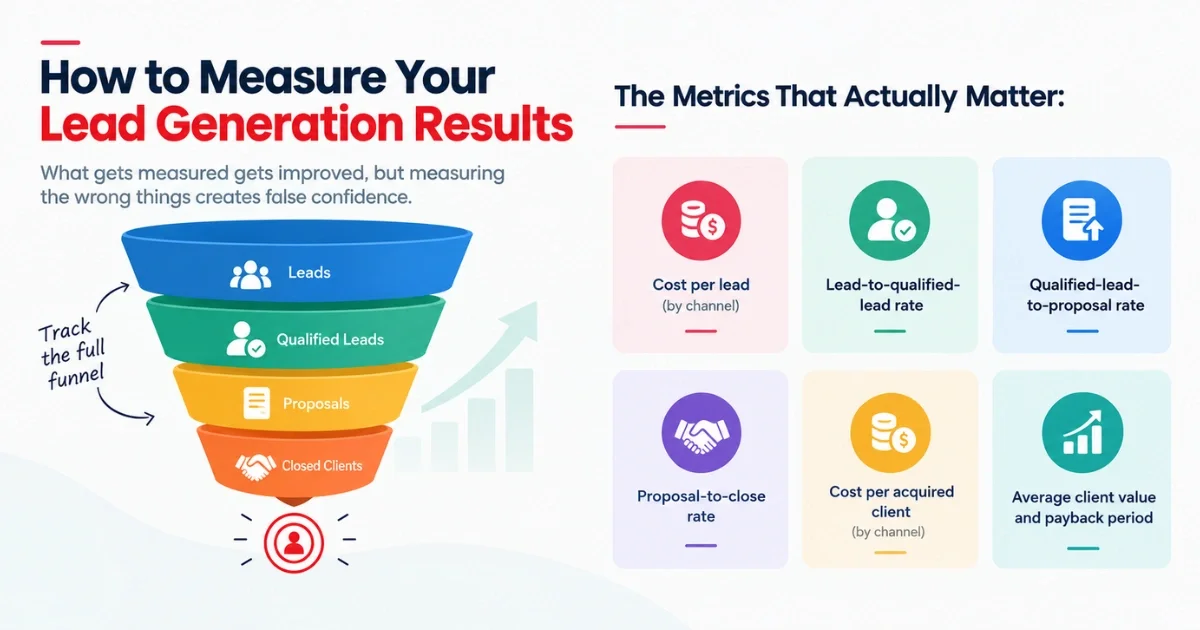
Cost per lead (by channel)
Lead-to-qualified-lead rate
Qualified-lead-to-proposal rate
Proposal-to-close rate
Cost per acquired client (by channel)
Average client value and payback period
A channel with a high cost-per-lead but strong close rate can be more profitable than a "cheap" channel that generates lots of unqualified leads.
Set up call tracking for phone-heavy businesses. For trades and local services, a large share of leads still come by phone. Without call tracking numbers tied to specific campaigns, you're flying blind on which channels actually drive revenue versus which just drive traffic.
Review data on a consistent cadence. Weekly for spend and lead volume (catch problems fast), monthly for conversion rates and channel ROI, quarterly for strategic channel mix decisions. Checking too infrequently means you waste budget on underperforming channels for months; checking too obsessively means reacting to normal week-to-week noise.
Calculate true ROI, not just ROAS. Return on ad spend (revenue ÷ ad spend) ignores your cost of delivery, sales time, and overhead. True ROI needs to account for gross margin, not just top-line revenue generated.
A Practical Lead Generation Plan for Service Businesses
Here's a realistic 90-day framework for a service business building or rebuilding its lead gen system:
Days 1–15: Foundation
Define ideal client profile using past client profitability data
Set up or clean up CRM
Audit and optimize Google Business Profile
Build/fix core landing pages for top 2–3 services
Days 16–45: Launch core channels
Launch Google LSAs and/or Search Ads for high-intent keywords
Start a structured referral ask process for existing clients
Set up automated follow-up sequences (instant response + cadence)
Begin collecting and publishing specific, detailed reviews
Days 46–75: Optimize
Review cost-per-lead and conversion by channel; cut or adjust underperformers
A/B test landing page headlines and CTAs
Add call tracking if not already in place
Start one longer-term channel (content/SEO or LinkedIn for B2B)
Days 76–90: Systematize
Document the sales process so it's not owner-dependent
Set monthly reporting cadence with the core metrics above
Identify the single best-performing channel and plan to double down
Set next-quarter targets based on real CAC and close-rate data
This sequencing matters, most businesses fail not because a channel doesn't work, but because they launch five things simultaneously with no measurement in place, then can't tell what actually drove results.
Common Lead Generation Problems and How to Fix Them
"We get leads but they don't convert."
Usually a follow-up speed or sales process problem, not a lead quality problem. Audit response times first, if the average is over an hour, fix that before touching your marketing.
"Leads are cheap but low quality."
Typically a targeting problem. Add qualifying questions to forms, tighten geographic and keyword targeting, and add negative keywords to paid campaigns.
"Referrals have dried up."
Referrals rarely dry up on their own, the ask usually stopped. Build a systematic, timed referral request into your client offboarding process rather than relying on it happening organically.
"We're spending on ads but can't tell what's working."
A tracking and attribution gap. Implement call tracking, UTM parameters on all campaign links, and consistent CRM source tagging before spending more, not after.
"Our website gets traffic but no leads."
Almost always a clarity or friction problem, unclear value proposition, buried contact info, too many form fields, or a slow mobile experience. Fix the page before increasing traffic to it; more visitors to a broken page just wastes more ad spend.
"Sales cycle is too long and leads go cold."
Needs a nurture sequence for the gap. Email/content touchpoints that keep you visible during a multi-month decision process (common in legal, consulting, and large home projects) prevent leads from forgetting you and choosing whoever they remember when they're finally ready.
Conclusion
Lead generation for service businesses isn't about finding one magic channel, it's about building a system where the right people find you, get captured properly, get followed up with fast, and get measured honestly enough that you know what to double down on. The businesses that consistently win aren't necessarily spending the most; they're the ones with the fewest leaks in their funnel, fast follow-up, clear qualification, and disciplined measurement. Start with the fundamentals in this guide, get one or two channels working well, and build outward from there.